Correction, 25 September 2026: An earlier version of this article, including its headline, said TfL had imposed a hard cap of 15 vehicles on the Uber/Wayve robotaxi trial, showing that limiting vehicle numbers was legally possible. That was wrong. TfL told LDV on 21 August that it did not cap the number of licences: the application was for 15 vehicles, and TfL limited its approval of Wayve’s vehicle modification to up to 15 vehicles on a trial basis. LDV should have corrected this article when TfL’s response arrived and apologises for the delay. The headline, introduction and the section on the robotaxi trial have been corrected. We have also clarified the table, which previously mixed driver and vehicle figures.
Analysis
Before London had a single robotaxi, it had a fifteen-year-old, still-unsolved problem: too many minicabs chasing too little work. TfL’s own Commissioner has admitted it. Two successive Mayors have asked Parliament to fix it. Neither has succeeded. And the robotaxi trial that began this summer does not change that. TfL says it limited its approval of the robotaxis’ equipment, not the number of licences, and it still has no power to cap the 94,258 private hire vehicles already on the road.
“Too much supply”: TfL’s own words
At a London Assembly Transport Committee session this year, TfL Commissioner Andy Lord confirmed the scale of London’s private hire fleet and, in the same breath, admitted the problem it creates: “we don’t have any powers to cap the number of private hire vehicles. It would require primary legislation change.” Pressed further, he was direct about the consequence: “At the end of the day, there will only be so much demand available, and if you’ve got too much supply, that starts to have a direct impact on their earnings and their ability to get a sustainable living.”
That is TfL’s own chief executive, on the record, confirming that London’s PHV market currently has more vehicles than there is work to sustain them, and that TfL has no legal tool to do anything about it. Nobody at TfL has ever published a figure for what the right number would be. Lord’s statement acknowledges the imbalance without quantifying it, which means London operates without either a demand target or a supply cap: only a regulator’s admission that the two are out of balance.
Fifteen years of the same warning
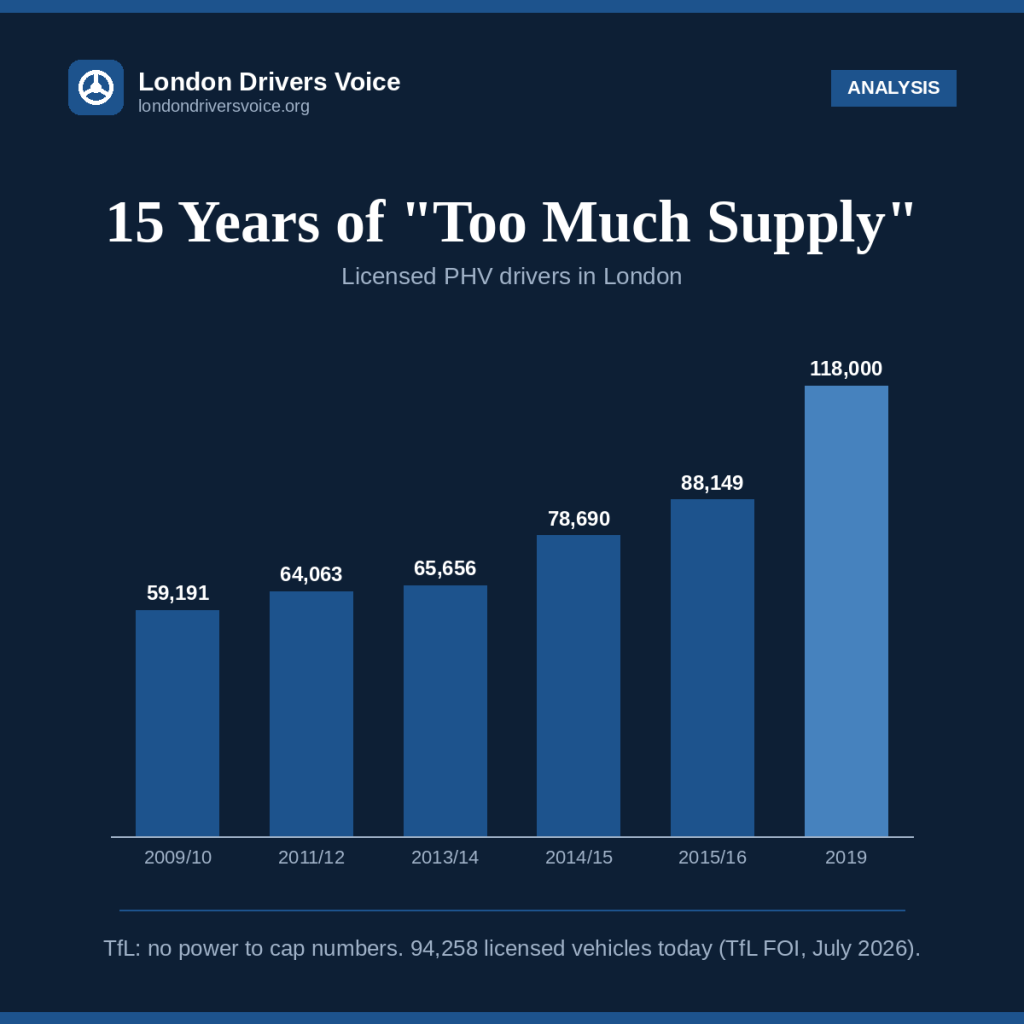
This is not a new complaint. London’s licensed PHV driver numbers have been tracked for over a decade and a half, and for most of that time they rose steeply:
| Year | Licensed PHV drivers |
|---|---|
| 2009/10 | 59,191 |
| 2011/12 | 64,063 |
| 2013/14 | 65,656 |
| 2014/15 | 78,690 |
| 2015/16 | 88,149 (growing ~2,000/month) |
| 2019 | 118,000 |
Driver and vehicle numbers are licensed separately and are not interchangeable. TfL’s response to LDV’s Freedom of Information request (July 2026) gives the current number of licensed private hire vehicles as 94,258. It did not give a current driver count, and no comparable, precisely sourced driver figure has been published since 2019, so a rise or fall in driver numbers since then cannot be read from these figures.
In 2016, then-Mayor Boris Johnson said plainly: “Londoners have embraced new technology… but we can’t continue to have more than 13,000 private hire drivers in central London and growing given the congestion that results,” and committed to pressing central government for capping legislation. That legislation never came. A decade later, the current Mayor’s administration is asking for the same power TfL’s Commissioner says it still doesn’t have. This is a cross-mayoral, cross-party failure to close a legislative gap: not a problem either TfL or any single Mayor created, and not one either has been able to fix alone.
The black cab trade collapsed in parallel
While PHV numbers climbed, London’s licensed taxi trade shrank by more than a third. Licensed taxis fell from 22,810 in 2013/14 to well under 15,000 a decade later, a 35% decline the Centre for London attributes partly to the cost of buying and running a cab and the barriers of the Knowledge. The Transport Committee’s own 2019 report, Raising the Bar, concluded the taxi and private hire sector had been “changed irreversibly by the advent of the app-only companies.”
A separate, independently sourced data point corroborates a pattern LDV has reported elsewhere: the number of licensed PHV operators (the companies, not the vehicles) fell from 3,038 in 2013/14 to 1,740 in 2023/24, even as the number of vehicles grew. TfL’s response to LDV’s Freedom of Information request put the figure at 1,868 in July 2026, still well under two-thirds of the 2013/14 level. Fewer companies, running more vehicles each. That is the same consolidation LDV’s reporting on Otto Car, Hertz and WeFlex’s collapse into Otto Car has documented from the fleet-supplier side, confirmed here from TfL’s own operator-licensing numbers.
The robotaxi trial is not a cap either
When TfL approved Uber and Wayve’s robotaxi trial in August, LDV reported that it had imposed a hard cap of 15 vehicles for one year, the very tool Andy Lord says TfL lacks. TfL has since told LDV that is not what happened:
“In this instance, an application was made to license 15 modified vehicles. PHV licences are granted for a year. TfL has approved the Wayve modification to be fitted on up to 15 vehicles on a trial basis. Rather than a cap on the number of licences, TfL has limited the approval of the vehicle modification itself, having approved it on a trial basis.”
The number 15 came from Uber and Wayve’s own application. What TfL limited was its approval of the Wayve AI Driver fitted to the cars, using the same prior-approval process that applies to any aftermarket modification to a licensed minicab, from a partition screen to a wheelchair ramp. That is consistent with Lord’s evidence, not a contradiction of it. TfL can decide whether a particular piece of equipment is fit to be fitted to a licensed PHV, and on what terms. It cannot decide how many ordinary PHVs London should have.
What London’s drivers are entitled to ask
Caroline Russell AM, who took over as Chair of the Transport Committee in May’s annual reshuffle, said at the time that scrutinising self-driving vehicles on London’s streets was top of her agenda. Two questions stand out.
The first is the old one. TfL’s own Commissioner says London has too much supply and that a cap would need primary legislation. What exactly have TfL and the Mayor asked government for, and what number of private hire vehicles would TfL consider sustainable? It is a figure TfL has never published.
The second is new. Because TfL approved the Wayve modification only on a trial basis, any wider rollout of these robotaxis in London depends on TfL deciding to extend that approval. When it is asked to, what evidence will TfL require, and will the effect on the earnings of London’s existing drivers be considered at all, or only passenger safety?
LDV’s earlier article on the robotaxi licence has been corrected in the same way and publishes TfL’s response in full: London’s First Robotaxi Licence, Two Weeks On: What TfL Actually Approved.
This article draws on Taxi Point’s reporting of Andy Lord’s comments to the London Assembly Transport Committee (March 2026); the Mayor of London’s 2016 press statement on private hire driver growth; BBC reporting on London Assembly concerns about PHV oversupply; the London Assembly’s 2019 report “Raising the Bar”; TfL’s own submission on taxi and operator licensing decline; TfL’s response to LDV’s Freedom of Information request (July 2026); TfL’s response to LDV on the robotaxi trial (21 August 2026); TfL’s published vehicle modification requirements; and London local news reporting on the Assembly’s May 2026 committee reshuffle.