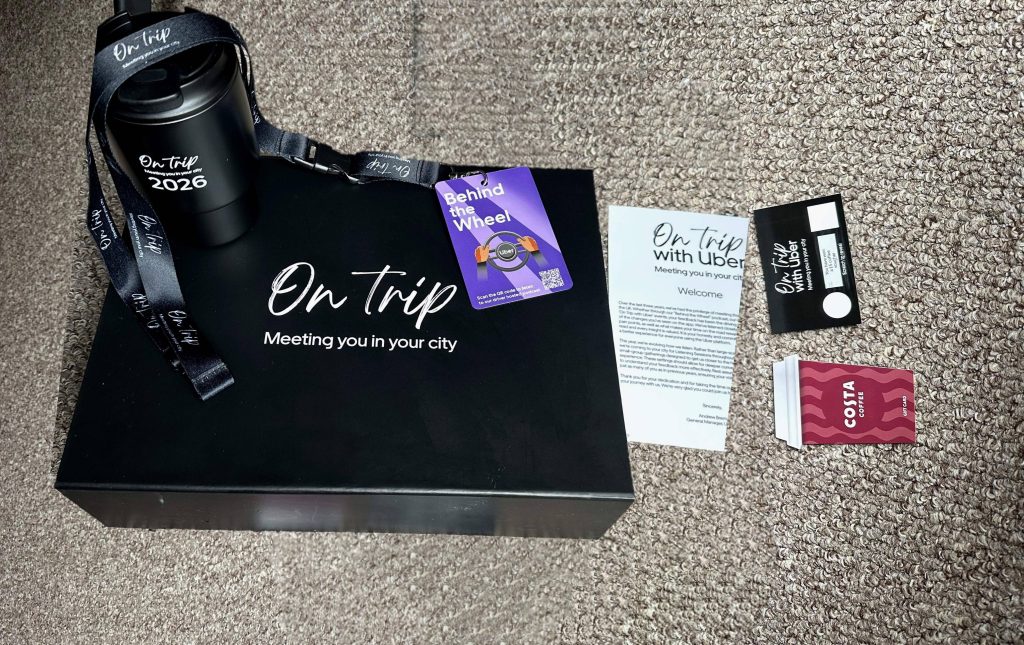
Uber invited London drivers to an “On Trip with Uber” Listening Session on 8 June 2026. Drivers were given a branded mug, a Costa voucher and a scratch card. They were also given a letter from Andrew Brem, General Manager Uber UK, promising that “every insight is valued.” LDV attended as a driver. Here is what was actually said in the room — and what Uber UK chose not to answer.
The Promise
Every attendee at the 8 June session received a welcome letter signed by Andrew Brem, General Manager of Uber UK. It set out Uber’s case for why the listening sessions matter:
“Your feedback has been the driving force behind many of the changes you’ve seen on the app. We’ve listened closely to your challenges and pain points… Each comment is read and every insight is valued.”
The format this year moved away from large-scale events toward small-group sessions — described in the letter as allowing “deeper conversations” so Uber can “understand your feedback more effectively.”
Attendees received a branded mug, a Costa Coffee voucher, and a scratch card on arrival, alongside tea, coffee, and light refreshments. One driver in the room scratched a £200 prize. The majority of attendees received the mug and voucher only. A separate driver survey, offering entry into a prize draw for £2,000, was also made available via QR code.
What none of this accounted for was the time itself. The session itself ran for over four hours, but for drivers travelling in, the real cost was closer to a full working day — two hours of travel either side of a four-hour session left little of the day available for paid work. Drivers were reimbursed £10 toward travel or parking costs. Against a realistic day’s earnings of around £300, that £10 covers roughly three percent of what was lost. There is no shift allowance, no appearance fee, nothing that accounts for the income a working driver forgoes by giving up the day. Around ten drivers did exactly that to take part. In return, alongside the £10 expense, Uber gained a room full of detailed driver insight, and sent drivers home with a mug, a voucher, and an empty pocket where a day’s income should have been.
LDV attended the London session as a driver, alongside around ten other licensed PHV drivers. Uber was represented by three members of its team, introduced as working within driver operations. What follows is drawn directly from that conversation.
|
£300
Income lost attending,
reimbursed £10 |
~50%
Commission on some
jobs, drivers said |
$20bn
Uber share buyback
authorised in 2025 |
An App Session, Not a Solutions Session
Strip away the format and what the 8 June session actually was becomes clear: a structured conversation about app features. MATCH, multi-stops, account holds, customer support scripts, ratings logic. Real issues, genuinely discussed — but every one of them a tweak to the interface, not a change to the economics underneath it.
No commission figure was put on the table. No fare structure was explained or defended. No timeline, no number, no commitment with a date attached. When drivers raised earnings collapse and the shareholder buyback directly, the response was sympathetic in tone but offered nothing that could be checked, measured, or held to later. That is the difference between being heard and getting a hard solution — and four hours in a room produced plenty of the first and almost none of the second.
What Uber Genuinely Heard
Within that narrow scope, Uber’s team did engage directly with what drivers raised, taking notes throughout and committing to follow up on specific trip examples.
Drivers described losing control over their own trips when riders add unplanned stops mid-journey, often without being asked. One driver recounted picking up a fare booked for nine miles at £18, only for the rider to add a stop — cutting the fare to £11 despite the additional distance. Uber’s team acknowledged that the rider currently holds all the control in this exchange and discussed introducing a financial penalty or an accept/reject option for drivers when a trip changes mid-route.
Drivers also raised the MATCH feature, describing scenarios where they accept a job through MATCH and are then allocated a different one entirely — creating confusion and wasted time. And several drivers described being offered jobs that would take them outside their licensed operating area, only to be removed from the app once they arrived, with no way back into the queue without a lengthy detour.
On account holds, the Uber team acknowledged that historic practice — taking drivers offline immediately on a single unverified rider report — was wrong, and said current process requires the driver’s side of the story to be heard before action is taken, except in the most serious safety cases. One driver described being blocked for 10 days following a dispute with two passengers who had been abusive in his vehicle; Uber’s representative called the outcome “appalling” and accepted the original handling fell short.
The offer card itself — the screen a driver glances at for a few seconds while deciding whether to accept a job — also came up. In this writer’s view, the card is cluttered with information that does little to help a fast decision and omits some of what actually matters. A “verified user” tick, for instance, appears on the screen without any explanation of what it verifies or why a driver should care. What drivers actually need in that moment — pickup area, postcode, fare, and estimated time — has to compete for space with badges and indicators that add noise rather than clarity. Anything beyond that core information belongs in the trip waybill, available after acceptance, not on a card a driver has seconds to read while watching the road.
It is hard, looking at additions like this, not to wonder whether some app changes are driven by what drivers actually need or simply by the fact that a development team exists and has to ship something. That is a suspicion, not a finding — but it is the kind of question a genuine listening session ought to be willing to ask Uber directly: who decided this feature was needed, what problem was it solving, and was any driver consulted before it shipped?
These are real commitments, made directly to drivers, and worth holding Uber to.
What the Session Couldn’t Touch
But beneath the operational fixes, drivers in the room described something the session was never structured to address: a collapse in earnings, and a collapse in trust.
Multiple drivers said their income had fallen sharply over recent years. One said work that paid £25–£30 an hour a decade ago now pays closer to £20. Another described a journey of nearly ten miles during a Tube strike — a fare a passenger said cost £85 — for which the driver received £26 after a small goodwill adjustment for the extended journey time. A third driver said comfort-tier trips, once paying £3–4 a mile, now barely reach £2.
One driver connected this directly to Uber’s financial position, telling the room: “On one side, Uber is announcing to their shareholders that $20 billion share buyback… we are struggling to meet our daily living cost.” He linked this explicitly to a breakdown in trust around Uber’s own earnings reporting — drivers, he said, no longer believe the weekly earnings figures Uber sends them accurately reflect what Uber retains.
Another driver put it more simply: several people in the room said they have stopped calling Uber support altogether, because experience has taught them it rarely changes the outcome.
This is not a complaint about a broken feature. It is a description of a relationship that has stopped functioning as a partnership — and no amount of MATCH-feature tuning resolves it.
The Question Uber Wasn’t Asked to Answer
The listening session was explicitly framed around app experience and driver operations. It was not designed as a forum for Uber’s commercial strategy — and to be fair to the format, it never claimed to be.
But that strategy is not a secret. Uber has told shareholders it intends to become the world’s largest facilitator of autonomous vehicle trips by 2029, backed by more than $10 billion in AV investment. Uber’s executive bonus structure is now tied in part to increasing the number of AVs on the platform. None of this was raised in the room on 8 June — not by Uber, and not by drivers, because the session was never built to hold that conversation.
That is precisely the gap this article is pointing to. Drivers were heard, generously, on the things the format was designed to hear. The questions that actually determine their future — what happens to earnings as AVs scale, where the margin from automation goes, and whether human drivers have any guaranteed place in Uber’s long-term model — sit entirely outside that format’s scope.
Right of Reply
LDV wrote to Uber UK’s press office on 9 June 2026, referencing Andrew Brem’s letter and asking three questions: whether Uber could point to specific, verifiable changes made as a result of previous listening sessions; how Uber would respond to the earnings and commission concerns raised by drivers on 8 June; and what mechanism exists to convert feedback from the session into measurable, trackable action.
A response was requested by 5pm on Wednesday 11 June 2026. No response was received.
What Would Make This Real
Andrew Brem’s letter says every insight is valued. Drivers in that room gave Uber a clear, specific, evidenced account of what is and isn’t working. The app-level issues — MATCH, multi-stops, account holds — got a real hearing and real, if informal, commitments.
But a listening session that only ever produces app fixes is, by design, incapable of answering the questions drivers actually came in with. Four hours of conversation closed with no commission figure, no fare commitment, and no answer on where the money drivers describe losing has actually gone. Until Uber is willing to bring hard numbers and dated commitments into the room — not just app changes — these sessions will keep solving the problems that are easiest to solve, while the ones that matter most go home with the drivers, unresolved, in the same car the mug came in.
If Uber wants these sessions to be more than a goodwill exercise, it needs to treat them as seriously as it expects drivers to. That means compensating drivers properly for the working time they give up to attend, and it means coming to the table with real answers — on earnings, on commission, on where the platform is heading — not just app tweaks and a scratch card.
It also raises a more basic question about the format itself. The three Uber representatives in the room were warm, attentive, and clearly experienced — but the questions they asked, the notes they took, and the follow-ups they offered all pointed to one function: app user research. They wanted to know how the interface felt to use, where it created friction, and what could be tweaked to smooth it out. That is a legitimate job, and they appeared to do it well. But it is not the same job as setting commission rates, fare structure, or AV strategy, and nothing in the room suggested any of the three had a hand in those decisions. If the people sent to listen are, in substance, a user research team rather than a policy team, then “every insight is valued” describes where feedback is recorded, not where decisions are made.
None of that was made clear before drivers gave up their day to attend. Andrew Brem’s letter invites drivers to share “challenges and pain points” without limit or caveat. If a session is, in practice, scoped to app experience and operational issues, drivers are entitled to know that before they sign up — not discover it four hours in, after raising the things that actually keep them up at night. A clearly defined scope, stated in advance, would let drivers decide whether the session is the right forum for what they want to say, and would stop Uber’s own language overselling what these sessions are built to deliver.