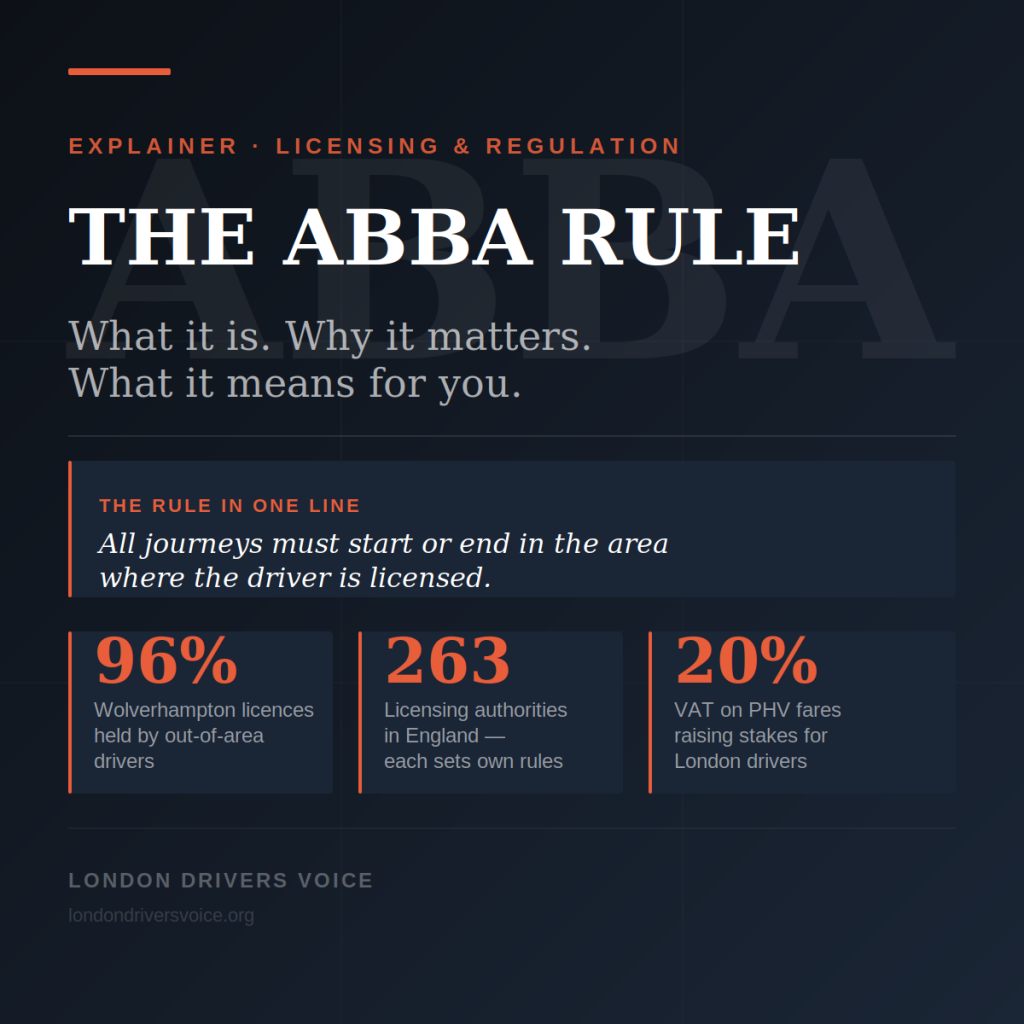
A single rule change could reshape who drives in London, who sets the standards, and how much platform workers earn. Here is what the ABBA proposal actually says — and what it means for every stakeholder in the for-hire vehicle market.
If you have ever wondered why a driver on Uber or Bolt might be licensed in Wolverhampton while picking you up in central London, the answer is cross-border hiring. And if you have ever heard the term “ABBA rule” and not known what it means, this article will explain it — including why it matters more in 2026 than at any point in the past decade.
The Current Situation
Under the Deregulation Act 2015, a PHV driver can be licensed by any local authority in England and then take bookings anywhere in the country. A driver licensed in Wolverhampton can legally pick up passengers in London, Manchester, Leeds, or any other city — even if they never drive in Wolverhampton itself.
This is known as cross-border hiring. And over the past decade, it has fundamentally changed the structure of the for-hire vehicle market in ways that neither passengers nor drivers fully understand.
The problem is not isolated. Unite the Union reports that at any point in 2025, more than 30 vehicles licensed by different authorities were operating simultaneously in Liverpool city centre. In Leeds, the figure was over 15. In London, where TfL sets its own licensing standards — among the most stringent in the country — the presence of out-of-area drivers operating under different rules creates a two-tier system on the same streets.
Transport Committee chair Ruth Cadbury has called this “licence shopping” — where drivers and operators seek out the authority with the least demanding checks, not because they are based there, but because it is easier and cheaper to get licensed there.
What the ABBA Rule Actually Says
“All journeys must start or end in the area where the driver, vehicle, and operator are licensed.”
The name ABBA comes from the A-to-B, B-to-A structure of the rule. It does not ban cross-border journeys entirely. A London-licensed driver could still pick up a passenger in London and drop them in Birmingham (A to B). A Birmingham-licensed driver could still pick up in London if they are dropping someone off there and taking a return booking (B back to A). What the rule prevents is a driver operating entirely outside their licensing area — taking journeys that neither start nor end where they are licensed.
The Taxi Task and Finish Group — a cross-party, cross-sector working group that included TfL, the Local Government Association, and key unions — recommended the ABBA approach in its formal report to government. TfL has publicly indicated that the model could help tackle the issues caused by cross-border hiring while still allowing suitable flexibility.
| Journey type | Allowed under current rules? | Allowed under ABBA? |
|---|---|---|
| London driver picks up in London, drops in Manchester | Yes | Yes — starts in licensed area |
| London driver picks up in Manchester, drops in London | Yes | Yes — ends in licensed area |
| Wolverhampton driver picks up in London, drops in London | Yes — under current rules | No — neither start nor end in licensed area |
| Wolverhampton driver picks up in London, drops in Wolverhampton | Yes | Yes — ends in licensed area |
| Any driver: airport run starting or ending in licensed area | Yes | Yes — preserved under ABBA |
The VAT Dimension — Why 2026 Has Raised the Stakes
The ABBA debate has taken on new urgency in 2026 because of the 20% VAT introduced on private hire fares from January 2026. The London Assembly Transport Committee has warned that the VAT change has created an uneven playing field between London-licensed drivers and out-of-area drivers working in London.
The reason is structural. TfL’s licensing rules prohibit the agency model used by some operators outside London. Under the agency model, the driver — not the operator — is treated as the supplier of the journey, which affects how VAT is calculated and in some cases allows operators to avoid charging VAT on the full fare. London-licensed drivers operating under TfL rules do not have access to this model.
The result, according to the London Assembly Transport Committee, is that out-of-area drivers can undercut London-licensed drivers on price while maintaining the same or better margins — not because they are more efficient, but because they are subject to different tax treatment. The Committee has warned this risks higher fares in London alongside squeezed incomes for TfL-licensed drivers.
What ABBA Means for Each Stakeholder
| Stakeholder | Current position | Under ABBA | Assessment |
|---|---|---|---|
| London PHV drivers | Competing with out-of-area drivers licensed under lighter-touch regimes | Level playing field — all drivers operating in London must be London-licensed | Positive |
| Out-of-area drivers (e.g. Wolverhampton) | Can work in London on cheaper licence | Must hold London licence to take London-only journeys | Negative — higher compliance cost |
| Platforms (Uber, Bolt) | Flexible driver supply from any licensed authority in England | Restricted deployment — drivers must be locally licensed for local trips | Negative — reduces supply flexibility |
| Passengers | Access to large supply of drivers — but inconsistent standards | Potentially fewer drivers in surge periods — but higher minimum standards | Mixed |
| Local authorities | Limited enforcement power over out-of-area vehicles | Clear geographic jurisdiction — can enforce against any vehicle operating locally | Positive |
| Licence-shopping councils | Revenue from licensing drivers who work elsewhere | Loss of licence fee income from out-of-area workers | Negative |
Where the Policy Stands Now
The Transport Committee’s inquiry into taxi and PHV licensing — which gathered evidence through late 2025 and whose recommendations were anticipated in early 2026 — explicitly examined cross-border working as one of its central questions. The inquiry has been described as a roadmap for reforming a framework that has not been significantly updated since the smartphone era began.
In November 2025, the government tabled an amendment to the English Devolution and Community Empowerment Bill that would give the Transport Secretary the power to introduce national minimum standards for PHV licensing. A consultation was also announced on reducing licensing authorities from 263 to 70 — a structural reform that would reduce but not eliminate the licence-shopping problem.
The government has confirmed it continues to consider wider options for reform including out-of-area working. The ABBA model is the most widely supported middle-ground proposal in that debate — endorsed by TfL, recommended by the Task and Finish Group, and supported by key trade bodies. It has not yet been legislated.
Sign the petition on driverless vehicles:
Petition 751258 calls on the government to halt driverless car deployment until driver protections are in place. Deadline: 17 June 2026. Sign here →
Are you a London PHV driver affected by cross-border hiring or the VAT change? Contact us → All submissions treated in confidence.