Correction, 25 September 2026: An earlier version of this article described TfL’s approval as a “hard cap” of 15 vehicles set by TfL, said this sat awkwardly with TfL’s position that it cannot limit PHV numbers, and said TfL had not explained the legal basis. TfL told LDV on 21 August that it did not cap the number of licences: the application was for 15 vehicles, and what TfL limited was its approval of Wayve’s vehicle modification, granted on a trial basis for up to 15 vehicles. LDV should have added TfL’s response when it arrived and apologises for the delay. The article has been corrected throughout and TfL’s response is published in full below.
Analysis
Two weeks ago, TfL licensed the first autonomous-capable vehicles to carry passengers in London, and they went to Uber, not Waymo. Since then, the fuller picture has come into focus: how narrow the approval actually is, what Uber and its partner Wayve have already said they want next, and how TfL limited the trial to 15 vehicles without, it says, capping licences at all.
What was actually granted
On 5 August, TfL granted Private Hire Vehicle licences to a small fleet of Wayve’s autonomous Ford Mustang Mach-Es. These are electric vehicles fitted with Wayve’s camera-and-radar “AI Driver” system, which notably uses no LiDAR and no pre-built street maps, a different technical approach from most rivals. The licences complete what TfL and Wayve both describe as the “triple-lock” requirement for any private hire trip in London: the operator (Uber, already licensed), the driver and the vehicle must all separately hold valid TfL licences before a single fare can be collected. A trained, TfL-licensed safety driver remains on board every trip, responsible for the vehicle at all times, and able to take the wheel if needed. TfL has been explicit about the category this sits in: the vehicles are “licensed as PHVs, not as automated vehicles”. No new licence type was created. Fully driverless operation, with no safety driver at all, would require a separate approval from DVSA under the Automated Vehicles Act 2024, which has not been sought or granted.
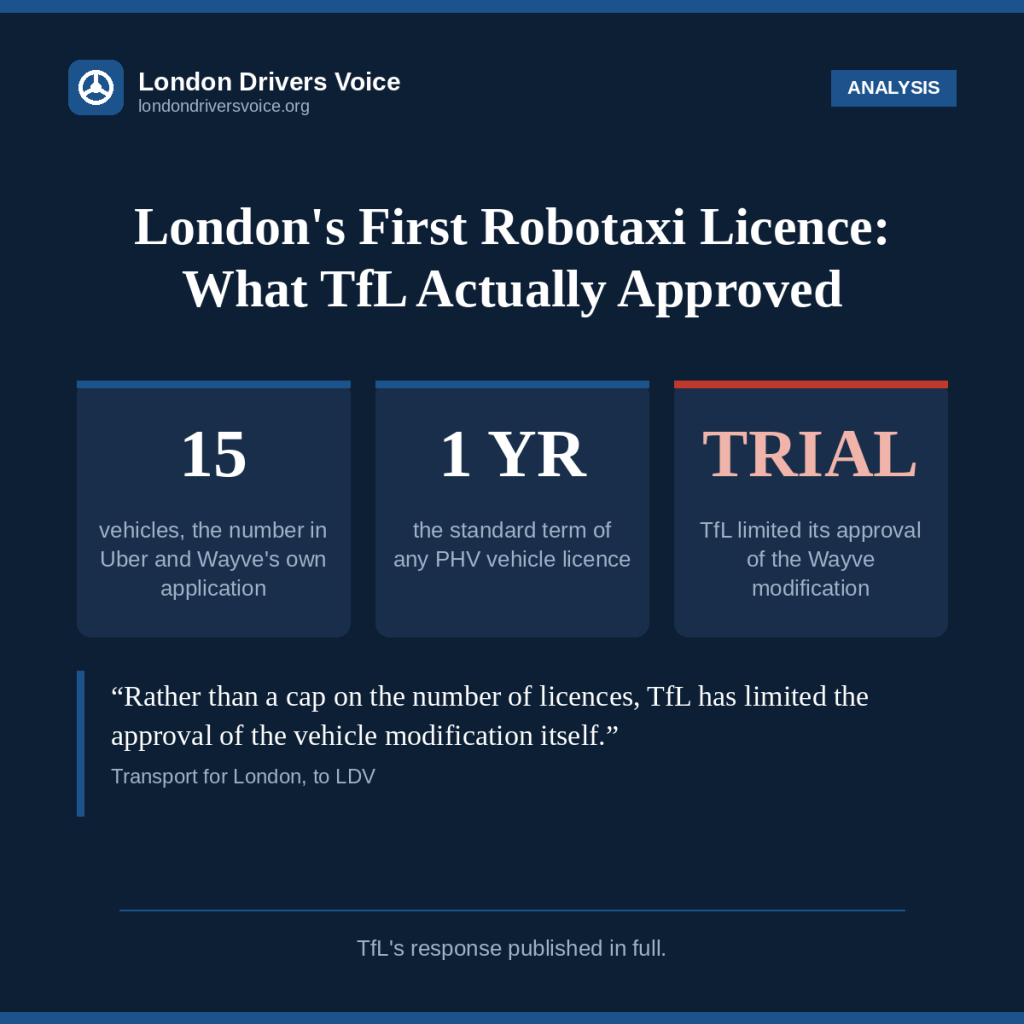
Uber and Wayve applied to license 15 vehicles. PHV licences run for one year, and TfL approved Wayve’s vehicle modification for use on up to 15 vehicles on a trial basis. Uber and Wayve said the first supervised passenger trips would begin this summer, initially limited to people who had registered interest (more than 100,000 Londoners did so in the eight weeks before the announcement), ahead of any wider public launch.
Uber first, ahead of two rivals who got there earlier
The order matters. Waymo has had a test fleet of roughly 100 vehicles operating with safety drivers across London since March, well before Wayve’s tests began. These are Jaguar I-Pace cars fitted with 29 cameras, 6 radars and 5 LiDAR units. Waymo does not yet hold a passenger-carrying licence. It has stated it is aiming for a fully driverless commercial launch in the fourth quarter of 2026, working with Moove as its London fleet operator, the same company confirmed elsewhere as Waymo’s operator in Phoenix, Miami and Las Vegas. Baidu’s Apollo Go, deployed through Lyft’s FreeNow platform, brings by far the largest global track record of the three: more than 22 million cumulative rides worldwide on its RT6 vehicles, which carry 38 sensors including 8 LiDAR units. But its London right-hand-drive testing, which began in Brent on 28 July, remains in early validation, with fare-paying rides not expected until 2027.
Uber, the most recent of the three to start road testing in London, is the first to reach paying passengers. One immediate effect of TfL’s approval is that London becomes one of the first cities anywhere where a US and a Chinese AV operator will compete head-to-head for the same market: Baidu via Lyft’s FreeNow, and, in the background, Waymo’s own approach once it clears TfL’s process.
The supervised trial is not the destination. In June, at the MOVE 2026 conference in London, Uber, Wayve and the carmaker Stellantis signed a non-binding memorandum of understanding to develop and deploy fully driverless Level 4 robotaxis at global scale. That agreement predates this licence. It makes clear that the current 15-vehicle, safety-driver-supervised trial is a first step Uber and Wayve have already said they intend to move beyond, not an end state.
Not a cap on licences, but a limit on the modification
TfL has told London’s PHV trade for over a decade that it has no legal power to limit how many private hire vehicles can be licensed: the law obliges it to grant a licence to anyone who meets the statutory requirements. When this article was first published, LDV described the 15-vehicle figure as a cap set by TfL and asked how that squared with TfL’s long-standing position. TfL’s response, in full:
“Transport for London (TfL) is legally obliged to issue a licence to anyone who meets the statutory criteria for licensing.
In this instance, an application was made to license 15 modified vehicles. PHV licences are granted for a year. TfL has approved the Wayve modification to be fitted on up to 15 vehicles on a trial basis.
Rather than a cap on the number of licences, TfL has limited the approval of the vehicle modification itself, having approved it on a trial basis. TfL will continue to closely monitor the use of these vehicles and take immediate action if passenger safety is compromised in any way.”
Two things follow. First, the number 15 came from the application, not from TfL. Uber and Wayve asked to license 15 vehicles. Second, the lever TfL used is its approval of the vehicle modification, the Wayve AI Driver fitted to the cars, not a limit on how many PHV licences can exist. That is consistent with TfL’s long-standing position rather than a departure from it. LDV’s original framing, that TfL had used a power over robotaxis it says it lacks over ordinary minicabs, does not hold.
The power itself is not new. TfL requires prior approval for any aftermarket modification to a licensed private hire vehicle, from a partition screen to a wheelchair ramp. Its vehicle inspection manual allows some modifications to be approved only after a special inspection or field trial, and says approval may be withdrawn if problems emerge. In Wayve’s case, TfL says the modifications were independently assessed by experts to confirm they do not compromise passenger safety and fall within the requirements of the Private Hire Vehicles (London) Act 1998, followed by a vehicle licensing inspection. What that process tests is whether the fitted equipment makes the car unsafe or unsuitable as a minicab. It does not test whether the software can drive. TfL requires a licensed PHV driver to be present and responsible for the vehicle at all times, and approval to carry passengers with no driver at all is a separate decision for the DVSA, through an Automated Passenger Services permit. In other words, London’s first robotaxi trial went through the same approvals route as any other minicab fitting. For now, the question of whether the AI drives safely rests on the licensed human behind the wheel.
That does not make the modification approval unimportant. Because TfL approved the Wayve modification on a trial basis for up to 15 vehicles, any wider rollout of these cars in London depends on TfL deciding to extend that approval. That decision, not the licence count, is the point to watch when Uber and Wayve seek to grow the fleet, along with the evidence TfL will require before agreeing. It does not, however, give TfL any new way to limit the conventional PHV fleet, where no such modification approval is involved.
What hasn’t moved at all
Driver displacement remains untouched by any of this. TfL has told LDV directly that it holds no projection of licensed PHV driver numbers over the next five years, and considers it “too early to make firm predictions” about how many AV operating licences it expects to issue. GMB’s regional organiser, Matthew Wright, responded to the Uber/Wayve licence by urging TfL to exercise “extreme caution” in deploying the technology.
Fifteen vehicles, each with a safety driver, displaces no one today. The real tests for driver livelihoods come at the next decisions: when TfL is asked to extend its approval of the Wayve modification beyond the trial, when DVSA is asked to approve fully driverless operation, when Waymo’s Q4 2026 target arrives, or when the Uber-Wayve-Stellantis ambition for global-scale driverless deployment reaches London specifically. None of those decisions has been made yet. All of them are now closer than they were two weeks ago.
This article updates LDV’s earlier coverage of TfL’s 5 August 2026 licence approval with reporting from Wayve’s own press materials, TechCrunch, Silicon UK, Tech Digest, Newmobility.news, Zag Daily and Local Transport Today, and TfL’s published vehicle licensing and modification requirements. It includes TfL’s responses to LDV on driver-number projections, AV licensing volumes and, as of 25 September 2026, the basis for the 15-vehicle limit.